

The Survivor trading advisor combines channel breakout entries with order-grid recovery — a pairing that usually spells blown accounts, but Survivor’s implementation is smarter than the typical martingale death spiral. Most grid EAs are designed to fail: they double down on losers until margin call. Survivor uses a channel breakout for entries and grids at a fixed distance with a stop-loss, which is the difference between gambling and systematic trading. Here is how the hybrid strategy works, what it does well, and where it still gets hurt.
| TL;DR | |
|---|---|
| Product | Survivor trading advisor (EA + settings files) |
| Platform | Not specified in the vendor materials — confirm before installing |
| Strategy type | Hybrid: channel trend algorithm (Bollinger Bands, RSI, ADX, DeMarker, MAs) for entries + order-grid recovery at fixed distance with SL and an order-count limit |
| Best for | Traders who understand grid risk and will test on demo before live |
| Key caveat | Any grid strategy underperforms pure trend-following in directional markets; on whipsaw-heavy pairs like GBPJPY the grid goes deeper than expected |
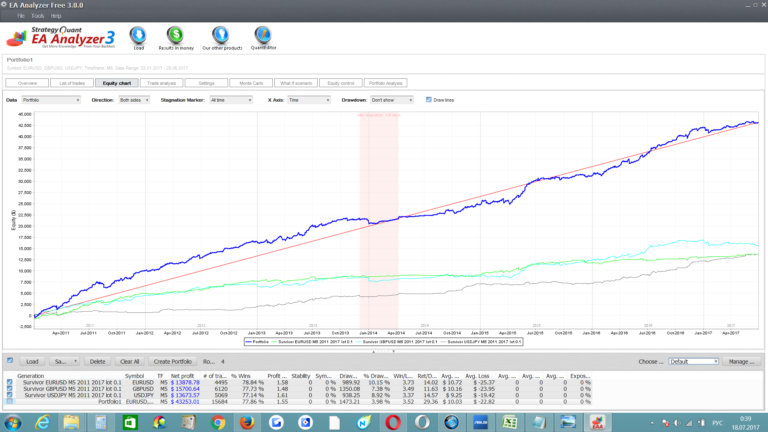
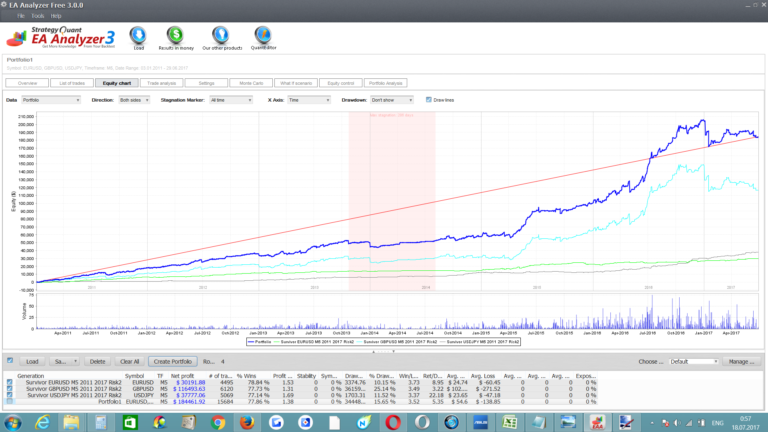
How Does the Survivor Trading Advisor Work?
The advisor runs two cooperating layers: a multi-indicator entry engine that finds trend-aligned entries, and an order-grid recovery system that manages positions when the market turns against them.
A channel breakout entry triggers when price breaks beyond a defined upper or lower channel boundary, signaling that a trend has gathered enough momentum to continue in the breakout direction.
An order grid is a sequence of pending or market orders placed at fixed price intervals, so that adverse moves are averaged out and a reversal to a chosen level closes the entire basket at a combined profit.
What Indicators Drive the Entry Signals?
Five standard indicators are combined, each covering a different aspect of market condition — which is what reduces the false-signal rate of single-indicator systems.
- Bollinger Bands: measure price volatility and flag overbought/oversold conditions.
- RSI (Relative Strength Index): measures buying vs selling strength and warns of potential direction changes.
- ADX (Average Directional Index): tells you how strong a trend is — and therefore whether it is worth following.
- DeMarker: helps identify moments when prices are about to reverse.
- Moving Averages: smooth price data so trends are easier to see.
Together these give the advisor a multi-angle read of the market before each entry, improving signal accuracy compared with any single indicator.
What Happens When the Market Turns Against a Position?
This is where the grid layer takes over — and where the design shows its differences from typical grid EAs.
When the market moves against an open position, the advisor automatically sets up an order grid: it adds positions at planned price levels as the move extends, and once price recovers to a profitable level, all orders close together. Risk is spread across the grid, reducing the average entry cost during adverse moves. Crucially, the grid has a hard limit on the number of orders — if prices move too wildly for the grid to handle, the system records the loss quickly instead of stacking infinitely, which protects capital in extreme conditions.
How Does Survivor Compare to Typical Grid EAs?
The differences are structural: capped depth, stop-losses on grid orders, and multi-indicator entries rather than blind averaging.
| Dimension | Survivor trading advisor | Typical martingale grid EA |
|---|---|---|
| Entries | Channel breakout confirmed by 5 indicators | Counter-entries at fixed intervals regardless of trend |
| Grid spacing | Fixed distance, configurable | Fixed or widening |
| Stop-loss | Grid orders carry SL | Often none until margin call |
| Grid depth | Hard cap on order count; cuts loss beyond it | Unbounded lot doubling |
| Weak spot | Whipsaw-heavy pairs (e.g. GBPJPY) still deepen the grid | Any strong trend blows the account |
Can You Customize the Settings?
Yes — the external settings let you tailor the advisor to your own risk level rather than accepting a fixed configuration.
- Initial position size
- Gap between grid orders
- Maximum number of grid orders
These options make it usable for experienced traders refining a strategy and for beginners starting out — though beginners should start at the most conservative settings available.
What Are the Advisor’s Stated Advantages?
The vendor highlights three, and they align with what the mechanics above actually deliver.
- Precise trend identification: the multi-indicator approach cuts false alarms and enters trends earlier than single-indicator systems.
- Robust risk management: the capped grid plus per-order stops limits how bad an adverse move can get.
- Market adaptability: the same framework can be applied across forex, stocks, and cryptocurrencies, in trending or sideways conditions.
These are design descriptions, not performance guarantees — the proof has to come from your own testing.
Is the Survivor Trading Advisor Right for You?
Only if you accept what grid systems inherently cost in strong directional markets.
⚠️ Understand This: Any grid-based strategy will underperform pure trend-following in directional markets. Survivor holds up on EURUSD, but on whipsaw-heavy pairs like GBPJPY the grid depth goes deeper than expected.
Risk Warning: trading always comes with risks. Even with an advanced tool like the Survivor trading advisor, there is no guarantee of profit. Consider your financial situation, trading experience, and risk tolerance before trading, and test it thoroughly in a simulated environment — learning its behavior, adjusting settings, and refining your strategy — before going live.
Download Survivor + sets (free)
The fair summary of the Survivor trading advisor: a hybrid channel-breakout and grid design that fixes the worst failure mode of grid EAs — unbounded averaging — but cannot repeal the fundamental trade-off that every grid system makes between recovery ability and tail risk.