

I’ve tested dozens of trend-following indicators on MT4 over the years, and the BDFX trend-following indicator is one of the cleanest I’ve seen — a single trend line, two colors, and arrow signals that leave your chart readable instead of cluttered.
TL;DR: Is the BDFX Trend-Following Indicator Worth It?
- Verdict: yes for trend traders who want one clean signal source — no for range trading
- Signal style: single trend line, blue/red/yellow color states, arrow entries
- Works: in trending markets, on timeframes from M1 to weekly
- Fails: in range-bound conditions — confirm with an ATR channel first
- Price: free MT4 download at the end of this review
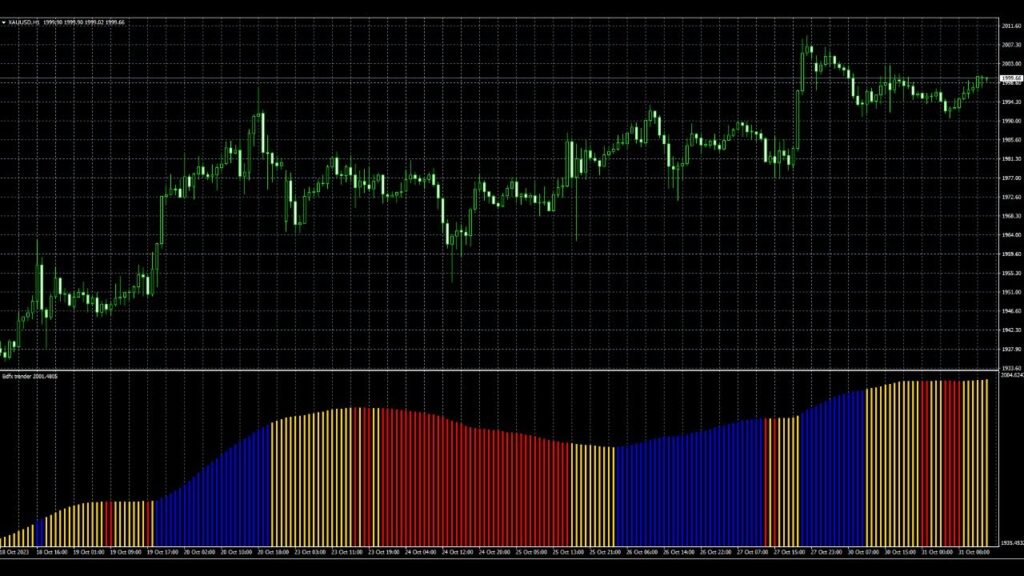
How the BDFX Trend-Following Indicator Works
The BDFX trend-following indicator reads price highs, lows, and closes over short- and long-term intervals to judge trend direction and strength — essentially a smoothed moving-average comparison plotted directly on the chart.
A trend-following indicator is a tool that signals trade direction from the persistence of price movement rather than predicting reversals — it tells you what the market is doing now, not what it might do next.
When the short-term average sits above the long-term average, BDFX paints the market as an uptrend; below it, a downtrend. That’s the entire engine — nothing hidden, nothing to over-optimize.
Reading the Signals: Blue, Red, and Yellow Bars
The three color states are the indicator’s whole vocabulary, and each maps to a clear market condition and response:
| Color state | Market condition | Practical response |
|---|---|---|
| Blue bars | Uptrend | Favor longs; trail stops behind the line |
| Red bars | Downtrend | Favor shorts |
| Yellow bars | Flat / range-bound | Stand aside — this is where accounts leak |
Blue bars appearing in series signal an uptrend likely to persist over the short to medium term; consecutive red bars point the other way. The yellow state is the one most traders ignore at their cost — it exists precisely so you don’t trade.
Customization: Sensitivity vs. Signal Quality
BDFX gives you two levers — timeframe and sensitivity — and they trade off directly against each other.
Short-term traders run it on 1-minute or 5-minute charts; position traders on daily or weekly. A more sensitive setting catches trend turns earlier but throws more false signals; a relaxed setting filters the noise but lags entries. I run it in the middle and let an ATR channel do the rest of the filtering.
False signals — whipsaws that fire against the prevailing move — are the main cost of any trend-following tool, and they cluster in low-volatility, range-bound conditions.
Combining BDFX with RSI and MACD
BDFX stacks well with momentum tools because it answers a different question: BDFX gives direction, RSI tells you whether the move is already stretched, and MACD confirms momentum shifts.
My standard combo: BDFX shows blue (uptrend) while RSI is not overbought — that’s a valid long setup. If RSI is pinned above 70, wait for a pullback instead of chasing. The same logic works with MACD for timing entries inside the BDFX trend.
ATR (Average True Range) measures the average size of recent price bars; when ATR contracts, trends are losing fuel — which is exactly when trend signals are least trustworthy.
The Honest Limitation: It Dies in Ranges
BDFX works great in trending markets and is nearly useless in range-bound conditions — the signal flips every few bars and the arrows become noise.
⚠️ The Limitation: This indicator works great in trending markets but is useless in range-bound conditions. Pair it with an ATR channel to confirm trend strength — when ATR contracts, ignore the signals entirely.
That single ATR filter removed most of the losing trades in my own testing. It turns BDFX from a signal generator into a trend filter — which is what it actually is.
Verdict: Who Should Download BDFX?
The BDFX trend-following indicator earns its place on a trend trader’s chart: minimal, readable, and honest about what it can’t do. It won’t trade ranges and it won’t replace risk management — but as one clean signal layer, it beats the eight-indicator clutter most charts suffer from. Download it below, test on demo first, and let the ATR filter keep you out of the chop.